
Warranty & Care
Limited Lifetime Warranty
Your Myerchin Marine Rigging Knife
Your Myerchin Marine knife is a precision tool. Like all precision tools, the manufacturing tolerances are very close; hence the clean open and snap (walk and talk) when the components are opened and locked. We continuously utilize our almost half a century of marine experience in the manufacturing process, constantly updating our techniques and materials as warranted by advances in the field. We make your knife function as well as possible in a harsh marine environment. It is imperative that the owner respect the integrity of the tool and treat it accordingly. After use near salt water, rinse the entire knife in fresh water and apply a few drops of oil to the two hinge pins. Make sure the mechanism is reasonably free of dirt and debris. While it is possible to manufacture a “rust-proof” knife… the resulting product performs very poorly. The pro-grade German marine stainless that we use is comparable to 440C for hardness and edge-holding properties with additional anti-oxidation elements added for the final crafting of our knives.
Our “Limited Lifetime Warranty” is as follows:
If your Myerchin Marine knife fails during reasonable use due to a manufacturing error or unseen defect, return it to us immediately for replacement or repair. Of course, this does not apply if the knife has been abused or used in an improper manner. Note that a well-used, well-cared-for knife is always covered for the lifetime of the original owner. Myerchin Marine will make the final decision on whether a knife has been abused or not.
- The warranty applies only to the original purchaser of the knife.
- When returning the knife to Myerchin, Inc., include a legible copy of the purchase receipt.
- Include $10.00 for shipping and handling.
- Return to: Myerchin, Inc.
40621 Chantemar Way
Temecula, CA 92591
Examples of what IS covered by this warranty:
- A knife where the back spring has fatigued and the blade/spike no longer lock.
- A defect in the metal casting resulting in a weak spot.
- A new knife with obvious manufacturing defects, e.g., cracked micarta, wood, etc.
Examples of what IS NOT covered by this warranty:
- An abused knife where the blade or spike has been used as a pry bar.
- An abused knife that has been left in a bilge or rusty toolbox and is frozen with dirt and oxidation. Obvious neglect.
What can you do if you have neglected your knife and the mechanism is frozen?
We suggest that you spray the knife liberally with WD-40 (or similar) in a Ziploc bag and leave it for a week or so. Usually this allows the oil to penetrate the mechanism so you can open the knife and carefully clean it. Most rust is surface (cosmetic) and simply needs to be loosened and cleaned.
Myerchin Sailor Tool Warranty:
Full year warranty. If you are unsatisfied within the first year, return for a replacement. Ideal tool for: Sailors, Merchant Seamen, Backpackers, Truckers, Climbers… anyone who regularly uses line in their daily work.
Safety Features, Use & Care
Sharpening the Traditional Style Blade.
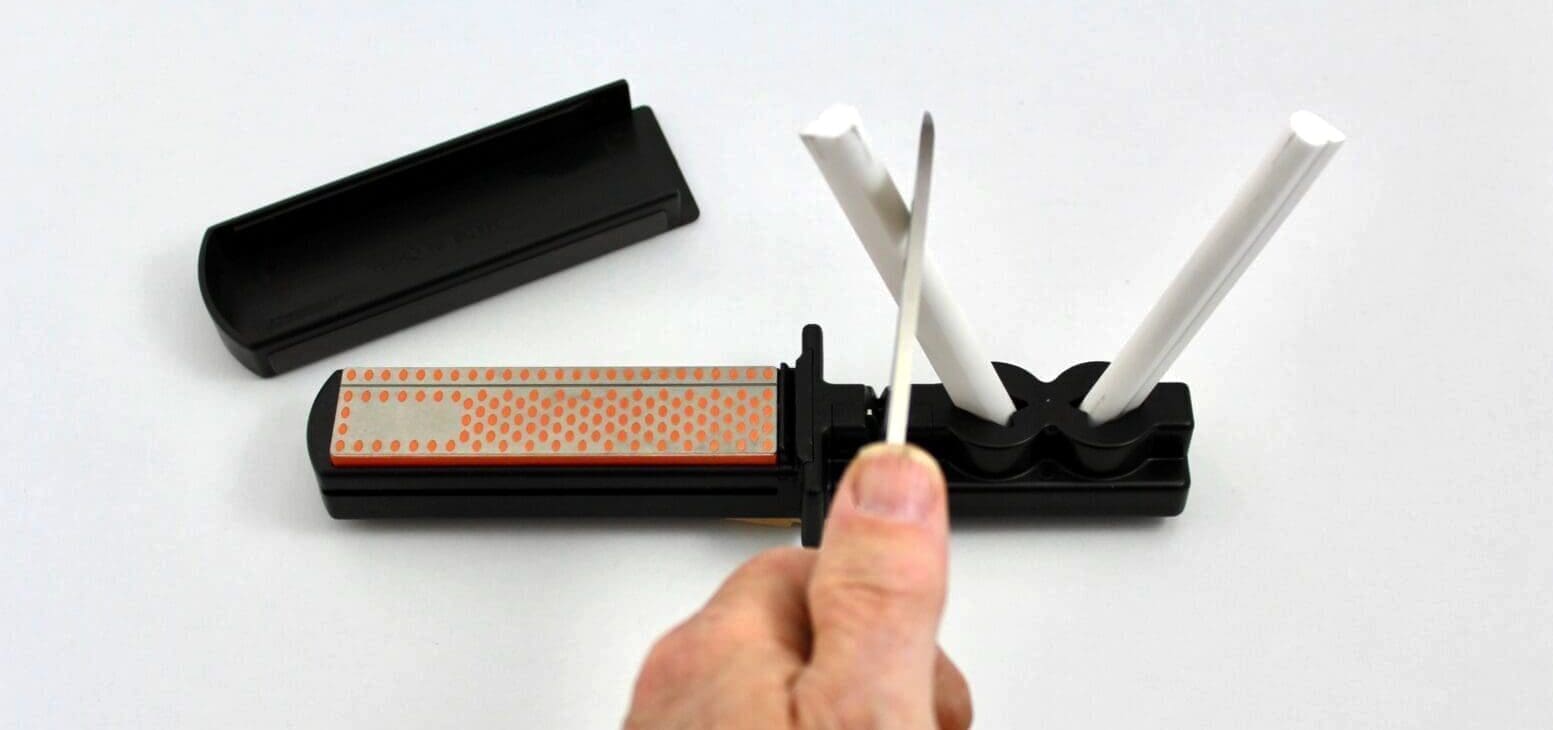
For the novice, we strongly recommend the pre-set “V” style sharpeners. These are sold at Amazon® and in many department and sporting goods stores. The beauty of this sharpener’s design is that the angle is pre-set for the novice. Other great choices include the Lansky® system. Obviously, the best sharpener is the whetstone. If you are well-versed in the use of the classic whetstone and have the skill to maintain a consistent angle… use the whetstone.
Amazon® carries many different sharpeners. We recommend that you stay away from the gimmick sharpeners and stick with the classics. You can also take your knife to a place that does professional sharpening. For periodic “touch-ups” to the blade, we recommend a common kitchen “steel.”
For sharpening a serrated blade, use one of the rods from a “V” style sharpener (or a tapered fine file for a chainsaw), available on Amazon®, and proceed as follows:
Inspect the serrations. One side is beveled… the other is flat. You will be working with the beveled side. Using the rod (or fine file) and following the angle of the bevel, lightly file each large serrated loop. Use a gentle motion and keep the rod (or file) at the same angle as the bevel.
After addressing each large loop several times, turn the blade over and, using the rod (or file), gently wipe the flat side of the blade. This is to remove any curl you may have caused in step one. The tip, or non-serrated portion of the blade, is sharpened just like a standard blade. That’s it… your Myerchin® serrated knife should be fine for a good long time.
Things you should “never” do to your blade:
- Never grind the blade… never improperly “file” the blade. A file is only used with a serrated blade… and then, very lightly. If the blade has really become “dull,” take it to a professional sharpener.
- Never use the blade or spike as a pry bar. They are finely tapered and not intended to be used as a prying tool.
- Never allow a knife to be “put away” that has been used in salt water. After use in salt water…ALWAYS rinse the blade (knife/spike) in fresh water and apply a fine oil (like WD-40). Knives stored in a rusty toolbox will accumulate “cosmetic” or surface rust. This is easily cleaned with stainless cleaners on exposed surfaces such as the blade or spike. However, when rust has been allowed to form on the hinges and spring, it is best to soak the entire knife in WD-40 and place it in a sealed plastic bag for several days. After this time has passed… work the knife and spike carefully until they are free.
- REMEMBER… it is possible to manufacture a “rust-free” knife, i.e., “diving knives”; however, “rust-free” knives are notorious for not holding an edge. The finest stainless steel knives must have some carbon in order to hold an edge (such as 440C). Myerchin® Rigging Knives have always utilized the highest quality stainless steel. The Pro-grade German Marine stainless that we use is comparable to 440C for hardness and edge-holding properties with additional anti-oxidation elements added for the final crafting of our knives. They hold an excellent edge… and they are definitely “rust resistant” if cared for properly. They should easily last a lifetime… or longer.